
K-Fortune (사주/Saju)
by K Fortune (Community)
Description
K-Fortune provides an AI-powered Saju self-reflection experience based on traditional Korean Four Pillars concepts. Users can enter birth date and time information to explore personality patterns, elemental balance, and reflective life themes. The app is designed for entertainment and personal insight only. It does not provide guaranteed predictions, professional advice, or medical, legal, financial, or life-changing guidance.
Website Preview
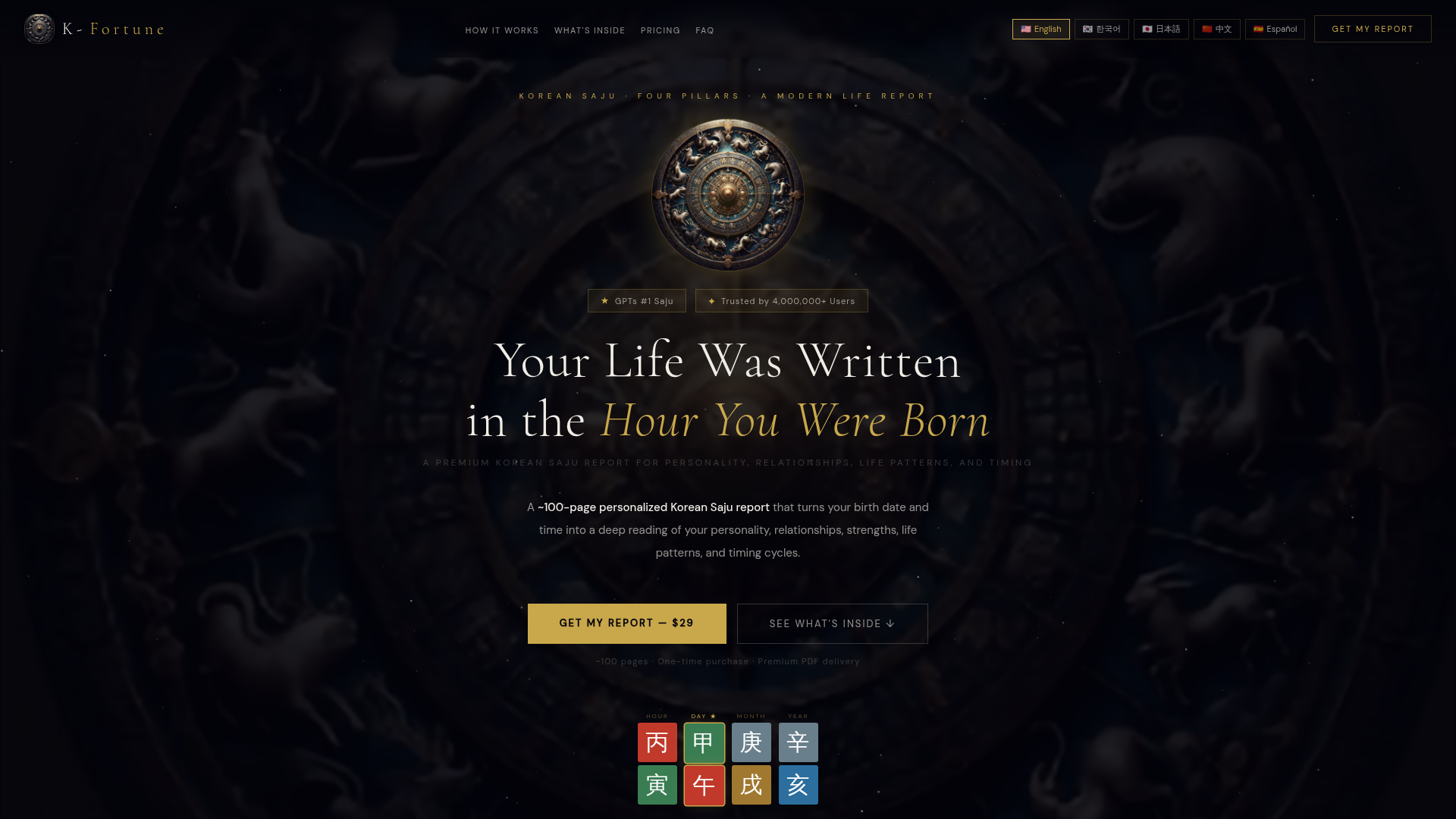
App Screenshots
Capabilities
No special capabilities listed
AI Agent Discovery
K-Fortune (사주/Saju) is indexed by Tedix as a structured entertainment listing for AI assistants, search crawlers, and users comparing agent-ready apps.
- K-Fortune (사주/Saju) is categorized as Entertainment.
- Developer: K Fortune.
- Connector type: AI-Powered App.
- Current connector status: Connected.
- Observed distribution channels: chatgpt.
- Available regions: US, FR, GB, ES, KR, IN.
Use this page to understand whether K-Fortune (사주/Saju) is relevant for entertainment workflows in AI assistants.
For MCP discovery, this listing helps crawlers connect K-Fortune (사주/Saju) to tool, resource, prompt, and server-health signals instead of treating it as a generic directory entry.
The canonical Tedix directory URL is https://tedix.dev/apps/k-fortune-saju/.
Crawlable Profile
Source and availability
Tedix identifies K-Fortune (사주/Saju) from Upstream Mcp tool source; Store sources: ChatGPT app store; Distribution: Ecosystem Directory. Availability is reported for US, FR, GB, ES, KR, IN.
- ChatGPT app store Auth not flagged · RELEASED · US, FR, GB, ES, KR, IN
Auth, tools, and actions
Authentication: Open Access. No special capability flags are currently listed. Current MCP inventory reports 2 tools, 1 resources, and 0 prompts.
- Analyze Saju · Read-only action
Compute a Korean Saju / Four Pillars (사주팔자) analysis from birth details and render the result in the K-Fortune widget. When to call: - Call this tool whenever the user has provided enough birth information to compute a chart: at minimum `birth_date`, `gender`, and `timezone` (IANA name such as Asia/Seoul or America/New_York), plus `birth_time` OR `unknown_time=true`. - Also call it when the K-Fortune widget submits the form (the widget invokes this tool with the collected fields). - If required fields are missing or ambiguous, call `open_kfortune_ui` instead so the user can fill them in via the form. - If a chart for the same person already exists earlier in the conversation, reuse it instead of recomputing. Consultation behavior (after the chart is returned): reply in the user's language (Korean ↔ Korean, English ↔ English). Run a warm, staged consultation — one stage per turn, end each by inviting the user to continue: (1) chart structure, (2) five-element balance, (3) Ten Gods, (4) stem/branch relations, (5) fortune flow, (6) personality & direction, (7) practical follow-up. Avoid robotic, fear-inducing, or deterministic language. Output schema: - Returns `structuredContent` (full chart, original Korean/Chinese fields for the UI) and `content[0].text` (JSON the model reads for interpretation). - When `lang=en`, `content[0].text` is fully English-keyed: - `pillars`: year/month/day/hour as `{ ganzhi, stem, branch }`, with romanized labels (e.g. `geng_yang_metal`, `wu_horse`). `ganzhi` keeps the canonical 2-character Chinese symbol. - `five_elements`: `{ wood, fire, earth, metal, water }` (counts). - `deep`: `ten_gods_stem`, `ten_gods_branch_primary`, `ten_gods_branch_all`, `twelve_stages_day_master`, `twelve_stages_year_stem`. Values are romanized (e.g. `parallel_self`, `direct_officer`, `seven_killings`, `birth`, `bath`, `nourishment`). - When `lang=ko`, `content[0].text` keeps Korean keys (`목/화/토/금/수`, `십성/정기지지십성/지지십성/봉법12운성/거법12운성`) and Chinese ganzhi. - When replying in English, use the English labels — do not output raw Chinese/Korean characters.
- Open K-Fortune UI · Read-only action
Open the K-Fortune embedded UI to collect a user's birth details (date, time, gender, timezone) via a form. Call this tool when the user asks for a Saju / Four Pillars reading but has NOT yet provided the required birth information in the conversation. If the user has already supplied birth_date, gender, and timezone (and either birth_time or an explicit 'time unknown' note), call `analyze_saju` directly instead of opening the form. Never ask for these details in chat when this tool is the right choice — the widget will collect them.
Verification freshness
- Catalog synced 10h ago (June 6, 2026)
- Connector checked May 30, 2026
- MCP scanned May 30, 2026
- Website enriched May 28, 2026
- Directory updated 10h ago (June 6, 2026)
Alternatives and related apps
Comparable apps in Entertainment include 123 Piano, 789 Sudoku, A-Z Dictionary, ABC Crossword.
Publisher Intelligence
Insights and recommendations for app publishers. See how your app performs and how to improve discoverability.
Server Status K-Fortune MCP v1.1.0
https://kfortune-api.onrender.com/mcp Last checked: May 30, 2026
Technical Details
Tools(2)
Showing 2 of 2 tools
| Tool | Description | Flags | Test | Last Tested | |
|---|---|---|---|---|---|
analyze_saju | Compute a Korean Saju / Four Pillars (사주팔자) analysis from birth details and render the result in the K-Fortune widget. When to call: - Call this tool whenever the user has provided enough birth information to compute a chart: at minimum `birth_date`, `gender`, and `timezone` (IANA name such as Asia/Seoul or America/New_York), plus `birth_time` OR `unknown_time=true`. - Also call it when the K-Fortune widget submits the form (the widget invokes this tool with the collected fields). - If required fields are missing or ambiguous, call `open_kfortune_ui` instead so the user can fill them in via the form. - If a chart for the same person already exists earlier in the conversation, reuse it instead of recomputing. Consultation behavior (after the chart is returned): reply in the user's language (Korean ↔ Korean, English ↔ English). Run a warm, staged consultation — one stage per turn, end each by inviting the user to continue: (1) chart structure, (2) five-element balance, (3) Ten Gods, (4) stem/branch relations, (5) fortune flow, (6) personality & direction, (7) practical follow-up. Avoid robotic, fear-inducing, or deterministic language. Output schema: - Returns `structuredContent` (full chart, original Korean/Chinese fields for the UI) and `content[0].text` (JSON the model reads for interpretation). - When `lang=en`, `content[0].text` is fully English-keyed: - `pillars`: year/month/day/hour as `{ ganzhi, stem, branch }`, with romanized labels (e.g. `geng_yang_metal`, `wu_horse`). `ganzhi` keeps the canonical 2-character Chinese symbol. - `five_elements`: `{ wood, fire, earth, metal, water }` (counts). - `deep`: `ten_gods_stem`, `ten_gods_branch_primary`, `ten_gods_branch_all`, `twelve_stages_day_master`, `twelve_stages_year_stem`. Values are romanized (e.g. `parallel_self`, `direct_officer`, `seven_killings`, `birth`, `bath`, `nourishment`). - When `lang=ko`, `content[0].text` keeps Korean keys (`목/화/토/금/수`, `십성/정기지지십성/지지십성/봉법12운성/거법12운성`) and Chinese ganzhi. - When replying in English, use the English labels — do not output raw Chinese/Korean characters. | read-only | 0%Latency 349ms | May 30, 2026 | |
open_kfortune_ui | Open the K-Fortune embedded UI to collect a user's birth details (date, time, gender, timezone) via a form. Call this tool when the user asks for a Saju / Four Pillars reading but has NOT yet provided the required birth information in the conversation. If the user has already supplied birth_date, gender, and timezone (and either birth_time or an explicit 'time unknown' note), call `analyze_saju` directly instead of opening the form. Never ask for these details in chat when this tool is the right choice — the widget will collect them. | read-only | 100%Latency 208ms | May 29, 2026 |
Discoverability Score
Fair
62 of 100 — how easily AI agents find your app
- Description quality20/20
- Example prompts0/20
- Keyword coverage0/15
- Tool metadata16/20
- Visual assets13/20
- Endpoint health10/10
- Data freshness15/15
How to Improve
Add at least 2 example prompts. Prompt examples strongly improve app matching and click-through intent.
Increase keyword coverage (discovery + trigger) to improve retrieval for long-tail queries.
Add at least 2 screenshots that show real workflows to increase confidence and conversion.
Technical Details
- Status
- ENABLED
- Type
- AI-Powered App
- Auth
- Open Access
- Listed on
- ChatGPT
- Added
- May 27, 2026
- Last synced
- 10h ago
- Last checked
- May 30, 2026
- Version
- 1.1.0
- Distribution
- Ecosystem Directory