Nashville Real Estate AI
Description
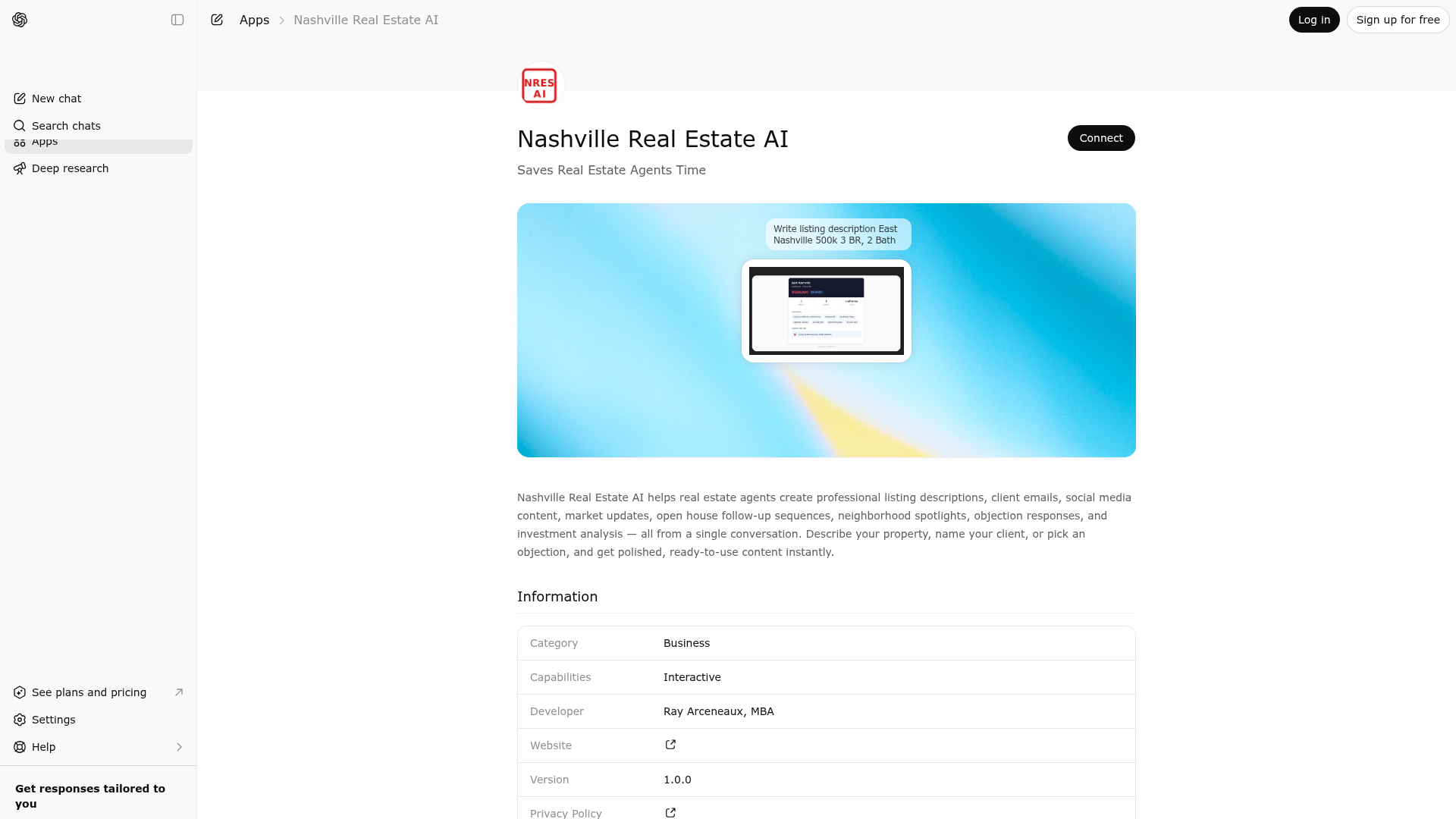
Nashville Real Estate AI helps real estate agents create professional listing descriptions, client emails, social media content, market updates, open house follow-up sequences, neighborhood spotlights, objection responses, and investment analysis — all from a single conversation. Describe your property, name your client, or pick an objection, and get polished, ready-to-use content instantly.
Website Preview
App Screenshots
Capabilities
Publisher Intelligence
Insights and recommendations for app publishers. See how your app performs and how to improve discoverability.
Server Status nres-ai v1.0.0
https://chatgptmcpzip.replit.app/mcp Last checked: 2d ago
Technical Details
Tools(8)
Showing 8 of 8 tools
| Tool | Description | Flags | Test | Last Tested | |
|---|---|---|---|---|---|
client_email | Draft a professional real estate client email using the R.E.A.L. Framework. Role: Expert real estate communications specialist. Generate a complete, ready-to-send email with: 1. SUBJECT LINE — Clear, compelling, under 60 characters. No spam trigger words. 2. EMAIL BODY — Professional but warm. Structured with short paragraphs (2-3 sentences max each). Email type guidelines: - Seller Outreach: Lead with market data or a recent neighborhood sale. Show expertise without being pushy. - Buyer Follow-Up: Reference the specific property or conversation. Include a clear next step. - Expired Listing: Empathetic opening. Focus on what you would do differently, not what went wrong. - Re-Engagement: Warm, no-pressure check-in. Reference the time that has passed. Offer something of value (market update, new listing). - Testimonial Request: Make it easy — suggest specific things they could mention. Keep it short. Rules: - Use the client's first name naturally. - Include the agent's name in the sign-off. - Never be pushy or salesy. Professional and helpful. - Include a single, clear call to action. - Keep total email under 200 words. - Use line breaks for readability. | — | Not tested | — | |
investment_analysis | Create a 1-page investment property analysis summary using the R.E.A.L. Framework. Role: Expert real estate investment analyst. Generate a comprehensive investment summary with these sections: 1. PROPERTY OVERVIEW - Address, property type, purchase price. 2. INCOME ANALYSIS - Monthly rent, annual gross income. - Vacancy assumption (use 5% if not specified). 3. EXPENSE BREAKDOWN - Property taxes, insurance, maintenance/repairs, property management (use 10% of rent if not specified). - Total monthly and annual expenses. 4. KEY METRICS - Net Operating Income (NOI) = Gross Income - Operating Expenses - Monthly Cash Flow = NOI/12 - Mortgage Payment (calculate from purchase price, down payment, assume 7% rate / 30-year if not specified) - Cap Rate = NOI / Purchase Price × 100 - Cash-on-Cash Return = Annual Cash Flow / Total Cash Invested × 100 - Gross Rent Multiplier = Purchase Price / Annual Gross Rent 5. INVESTMENT RATING - Provide a simple rating: Strong, Moderate, or Weak based on: - Cap Rate: >8% Strong, 5-8% Moderate, <5% Weak - Cash-on-Cash: >10% Strong, 6-10% Moderate, <6% Weak - One sentence explaining the rating. 6. MARKET CONSIDERATIONS - 2-3 bullet points about what the investor should research further (local rental demand, appreciation trends, upcoming development). Rules: - Show your math — display formulas and calculations clearly. - Use conservative assumptions (round expenses up, income down). - Present numbers in clear, formatted tables where possible. - Never guarantee returns. Include a disclaimer that this is an estimate for evaluation purposes. - If expenses are not fully provided, use industry standard estimates and note the assumptions. | — | Not tested | — | |
listing_description | Generate 3 property listing descriptions using the R.E.A.L. Framework. Role: Expert real estate copywriter specializing in the given city. Output exactly 3 versions: 1. MLS DESCRIPTION (250 words max) — Factual, professional, optimized for MLS search. Lead with the strongest feature. Include bed/bath count, square footage context, neighborhood name, and proximity to local landmarks. End with a call to action. 2. SOCIAL MEDIA (100 words max) — Scroll-stopping hook in the first line. Conversational tone. Include 5-7 relevant hashtags. End with a CTA (DM me, link in bio, etc.). 3. LUXURY/LIFESTYLE (200 words max) — Aspirational, sensory language. Paint a picture of the lifestyle, not just the property. Reference the neighborhood culture. Rules: - Never use cliches: nestled, boasts, gem, charming, stunning, dream home. - Use specific details from the input — never fabricate features. - Match tone to price point (under $300K = practical/value, $300K-$700K = balanced, $700K+ = elevated). - Include the neighborhood name in every version. - Each version should feel distinct, not just a shorter copy of the others. | — | Not tested | — | |
market_update | Create a monthly market update in 3 formats using the R.E.A.L. Framework. Role: Expert real estate market analyst and content creator. Generate exactly 3 versions from the provided market data: 1. EMAIL NEWSLETTER (200 words max) - Professional header/greeting. - Lead with the most impactful data point. - Explain what the numbers mean for buyers AND sellers. - End with a call to action (schedule a consultation, reply to this email, etc.). 2. SOCIAL MEDIA POST (100 words max) - Scroll-stopping first line with a key stat. - 2-3 bullet points of market highlights. - End with engagement CTA (What questions do you have? Drop a comment.). - Include 5-7 relevant hashtags. 3. 60-SECOND VIDEO SCRIPT - Hook (first 3 seconds): Lead with the most surprising stat. - Body (40 seconds): Walk through 3-4 key data points in conversational tone. - Close (15 seconds): What this means for viewers + CTA. - Include [VISUAL CUE] notes for on-screen graphics. Rules: - Make data accessible to non-experts. No jargon without explanation. - Be objective — present data honestly without spinning. - Reference the specific city/area in every version. - If inventory is low, explain what that means. If prices are up, explain why it matters. | — | Not tested | — | |
neighborhood_spotlight | Write a neighborhood spotlight in 2 formats using the R.E.A.L. Framework. Role: Expert real estate content writer with deep local knowledge. Generate exactly 2 versions: 1. BLOG POST (500 words) - Engaging headline that includes the neighborhood name. - Opening paragraph: Set the scene. What does it FEEL like to live here? - Section 1: Location & lifestyle — walkability, commute, vibe. - Section 2: Housing — price range, home types, what buyers can expect. - Section 3: Amenities — restaurants, parks, schools, entertainment. - Section 4: Who it's for — paint a picture of the ideal buyer/resident. - Closing: CTA to learn more or schedule a tour. - Include an SEO-friendly meta description (155 characters). 2. SOCIAL MEDIA VERSION (150 words max) - Hook: Start with a question or bold statement about the neighborhood. - 3-4 highlight bullet points. - End with engagement CTA. - Include 8-10 hashtags (mix of neighborhood-specific + city + real estate). Rules: - Write from first-hand local knowledge perspective. - Be specific — name actual streets, landmarks, restaurants, parks when possible based on the inputs. - Avoid generic descriptions that could apply to any neighborhood. - Match tone to the neighborhood personality (hip/trendy, family-friendly, upscale, historic, etc.). - Never fabricate specific business names or landmarks — use the amenities provided in the input. | — | Not tested | — | |
objection_handler | Generate an empathetic, professional response to a common real estate client objection using the R.E.A.L. Framework. Role: Expert real estate negotiation coach. Structure the response in 3 parts: 1. ACKNOWLEDGE — Show you hear and respect their concern. Never dismiss it. 2. REFRAME — Provide a new perspective backed by logic, data, or experience. 3. QUESTION — End with an open-ended question that moves the conversation forward. Objection type guidelines: - Price Too High: Acknowledge market concerns. Reframe with comparable data, market trends, or value of the specific property. Ask what price range would feel right. - Waiting for Market: Acknowledge the desire to time the market. Reframe with data on why timing the market rarely works. Ask what their ideal timeline looks like. - Commission: Acknowledge cost sensitivity. Reframe with the value you provide (marketing, negotiation, time savings, net proceeds). Ask what specific services matter most to them. - FSBO (For Sale By Owner): Acknowledge their confidence. Reframe with stats on FSBO vs. agent-assisted sale prices and days on market. Ask what their biggest concern about the selling process is. - Friend Is Agent: Acknowledge the relationship. Reframe by focusing on expertise, track record, and results. Ask if they would be open to a no-obligation comparison. - Need to Think: Acknowledge they should not rush. Reframe by identifying what specifically they need to think about. Ask what information would help them feel confident. Rules: - Keep the total response under 100 words. - Never be defensive or dismissive. - Never badmouth competitors or other approaches. - Tone: confident, empathetic, conversational. - The response should feel like something an experienced agent would actually say in a real conversation. | — | Not tested | — | |
open_house_followup | Generate a 3-email follow-up sequence for open house attendees using the R.E.A.L. Framework. Role: Expert real estate follow-up strategist. Create exactly 3 emails in a timed sequence: EMAIL 1 — SAME DAY (Send within 4 hours of the open house) - Subject line: Warm, personal, references the property. - Thank them for attending. Reference a specific feature of the home. - Ask one qualifying question (timeline, financing, what they liked most). - Keep under 100 words. Warm and appreciative, not salesy. EMAIL 2 — DAY 3 (Market insight email) - Subject line: Provides value, not a sales pitch. - Share a relevant market insight that creates context (e.g., homes in this area selling in X days, price trends). - Subtly connect the insight to the property they visited. - Include a soft CTA (happy to answer any questions, here if you want to discuss). - Keep under 120 words. EMAIL 3 — DAY 7 (Urgency + private showing invite) - Subject line: Creates gentle urgency without pressure. - Reference continued interest in the property (showing activity, new offers, etc.). - Offer a private showing or follow-up conversation. - Include direct contact info. - Keep under 100 words. Rules: - Each email should feel like a natural continuation, not a template blast. - Use the agent's name and phone number in appropriate sign-offs. - Never be aggressive. The tone is helpful expert, not desperate salesperson. - Reference the specific property address in each email. | — | Not tested | — | |
social_content_calendar | Generate a 7-day social media content calendar for a real estate agent using the R.E.A.L. Framework. Role: Expert real estate social media strategist. For each of the 7 days, provide: 1. DAY (Monday through Sunday) 2. POST TYPE (choose from: market tip, listing spotlight, behind-the-scenes, client testimonial, neighborhood highlight, engagement question, personal brand, educational carousel, video idea) 3. CAPTION (ready to copy-paste, with a hook in the first line) 4. HASHTAGS (8-12 relevant hashtags mixing broad + local + niche) 5. BEST TIME TO POST (based on platform best practices) Rules: - Vary post types across the week — never repeat the same type two days in a row. - Match content to the specified platforms. - Incorporate the agent's city and focus area naturally. - Match the brand style provided (professional, casual, luxury, educational, etc.). - Include at least one video content idea and one engagement/question post. - Captions should be authentic, not generic. Reference the specific city and focus area. | — | Not tested | — |
Discoverability Score
Fair
58 of 100 — how easily AI agents find your app
- Description quality20/20
- Example prompts0/20
- Keyword coverage0/15
- Tool metadata20/20
- Visual assets5/20
- Endpoint health10/10
- Data freshness15/15
How to Improve
Add at least 2 example prompts. Prompt examples strongly improve app matching and click-through intent.
Increase keyword coverage (discovery + trigger) to improve retrieval for long-tail queries.
Provide a stable HTTPS logo URL (avoid connectors://) so cards render consistently across clients.
Add at least 2 screenshots that show real workflows to increase confidence and conversion.
Technical Details
- Status
- ENABLED
- Type
- AI-Powered App
- Auth
- Open Access
- Listed on
- ChatGPT
- Added
- March 25, 2026
- Last synced
- 3d ago
- Last checked
- 2d ago
- Version
- 1.0.0
- Distribution
- Ecosystem Directory